

Choosing Goethe and Faust
When trying to decide the classic book to read for my trip to Germany, I was spoiled for choice. German literature is vast and as complicated as the history of Germany itself, shaped over centuries by shifting borders, empires, and ideas of national identity. Even pinning down on what counts as German literature proved difficult because I wanted something set in Germany, but many books written in the German language emerged from places that are not from Germany today. From the Holy Roman Empire through the conflicts between Prussia and Austria and the unification of the German states into a single empire in 1871, political change frequently altered the German-speaking world. With frequent and constant change to the country, writers drew from the world they lived in and it was reflected in their writing. And that’s not even getting into the twentieth century.
I was initially tempted to read the fairy tales from the Brothers Grimm, whose work helped express a shared German cultural identity despite political and geographic fragmentation. I also thought those stories would be an interesting companion piece to the Hans Christian Andersen fairy tales I’d read for my Denmark visit, offering a chance to see how the stories compared and how that might have reflected differences in the time period and cultures. I also considered reading early twentieth century pieces to understand the impact the First World War and the desperation that would have made German citizens vulnerable and willing to put their faith into someone like Hitler. But as I researched, I kept going back to Goethe. I had read Faust, Part One during college, but I had never read it in its entirety, and Goethe’s influence on German literature, and Western literature as a whole, made him the most compelling choice.
I ultimately chose to read Faust and shaped my itinerary based on what I read: Mount Brocken, where Goethe walked and found inspiration for the Walpurgis Night scenes in Faust, and Frankfurt, where he was born.
A Lil Bit About German Literature and Faust
Goethe worked on Faust over the course of roughly 60 years. He wrote the early version, Urfaust, during the 1770s, Faust, Part One was released in 1808, and Faust, Part Two was published posthumously in 1832. The long composition history allowed the play to reflect the shifts in Goethe’s thinking over time as well as the changes in German literature. Early in his career, Goethe was one of the leading figures of the Sturm und Drang (Storm and Stress) movement, which rebelled against the Enlightenment’s emphasis on reason by focusing on emotion, nature, and the individual. However, when he left Frankfurt for Weimar and began to travel more widely, his perspective changed and he began to favor a balance of reason and beauty, striving towards the idea that an individual can be intellectual, creative, and moral, which became the tenets of Weimar Classicism.
In Faust, the tension between Enlightenment reason and the emotionality of Strum and Drang are on display. During Faust, Part One, Faust is depressed because he is not fulfilled, despite his knowledge and intellect, having mastered all the subjects. This illustrates the limitations of reason and knowledge in satisfying an individual. His wager with Mephistopheles gives him the opportunity to pursue experience. Mephistopheles may claim his soul only if Faust becomes satisfied to the point that he ceases striving and becomes complacent. During this part of the play, Faust throws himself into a passionate love affair with Gretchen, but his pursuit of experience destroys her life. After meeting him, she accidentally poisons her mother to spend the night with Faust, becomes pregnant with his child, and her brother is killed in a duel with Faust, who immediately flees. In despair, she murders her newborn and is imprisoned. Through Faust’s dealings with Gretchen, Goethe explores the destructive consequences of allowing emotions and individual desire to overwhelm moral responsibility. Faust might be gaining experience, but it comes at the cost of Gretchen’s suffering and moral ruin.
Faust, Part Two, written much later than Faust, Part One, strikes a different tone. It’s less straightforward, relies heavily on allegory, and features political figures as well as figures from Greek mythology. It is a strange, difficult read, and because it’s so esoteric it is staged less frequently than its predecessor. Towards the end, Faust begins to move away from selfish desires and turns his energy towards building a bettering society. He dies at the moment he imagines that vision being fulfilled. Although Mephistopheles tries to claim Faust’s soul to fulfill the terms of their wager, Faust is ultimately saved and redeemed because he was never spiritually complacent, continuing to strive until his death.
For me, the differences between these literary and intellectual movements are best encapsulated by the contrasting redemptions of Gretchen and Faust. Both are saved through divine intervention, though for radically different reasons. Gretchen is saved after repenting for her sins and asking forgiveness, rejecting the magical aid Faust could give her in favor of facing her execution to meet God’s judgment. Her salvation follows the traditional Christian moral framework, where your redemption hinges on repentance and forgiveness. In contrast, Faust does not express guilt and does not repent for his sins nor the suffering he’s caused, but rather he is ultimately redeemed despite his sins because of his continuous striving. By the end, his ambition shifts away from himself and towards a project intended to benefit others. By redeeming Faust, Goethe reworks the traditional Faust legend, which often served as a cautionary tale about abandoning the holy word for worldly knowledge; in older versions of the story, such as the play by Christopher Marlowe, Faust is damned. Goethe rejects this ending, instead making the idea of striving a key point of redemption. This emphasis on striving reflects the German ideals of Bildung (self‑cultivation) and Streben (striving) while also acknowledging the limits of pure reason that Goethe and other writers explored during the Sturm und Drang period.
Brocken
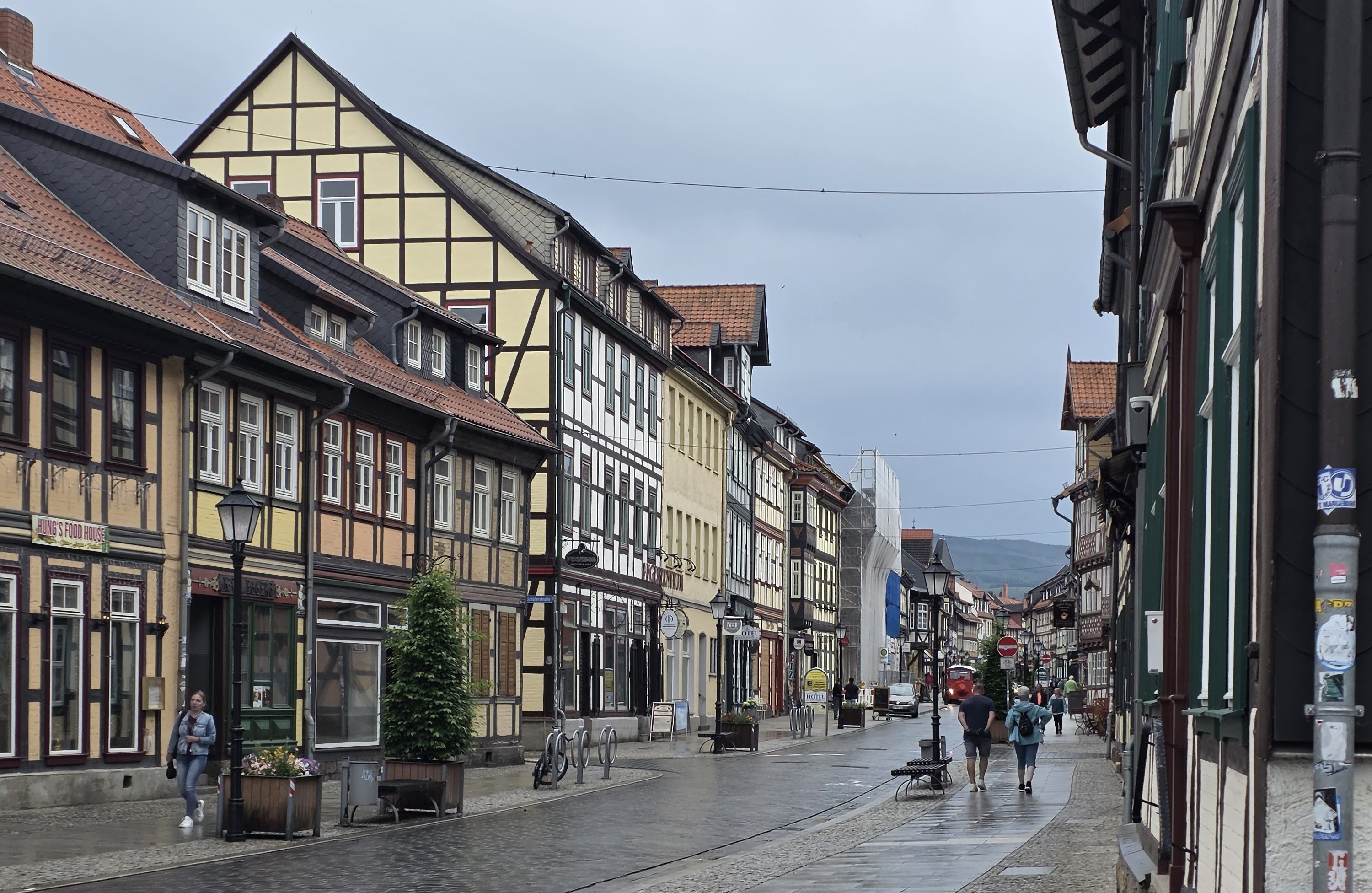
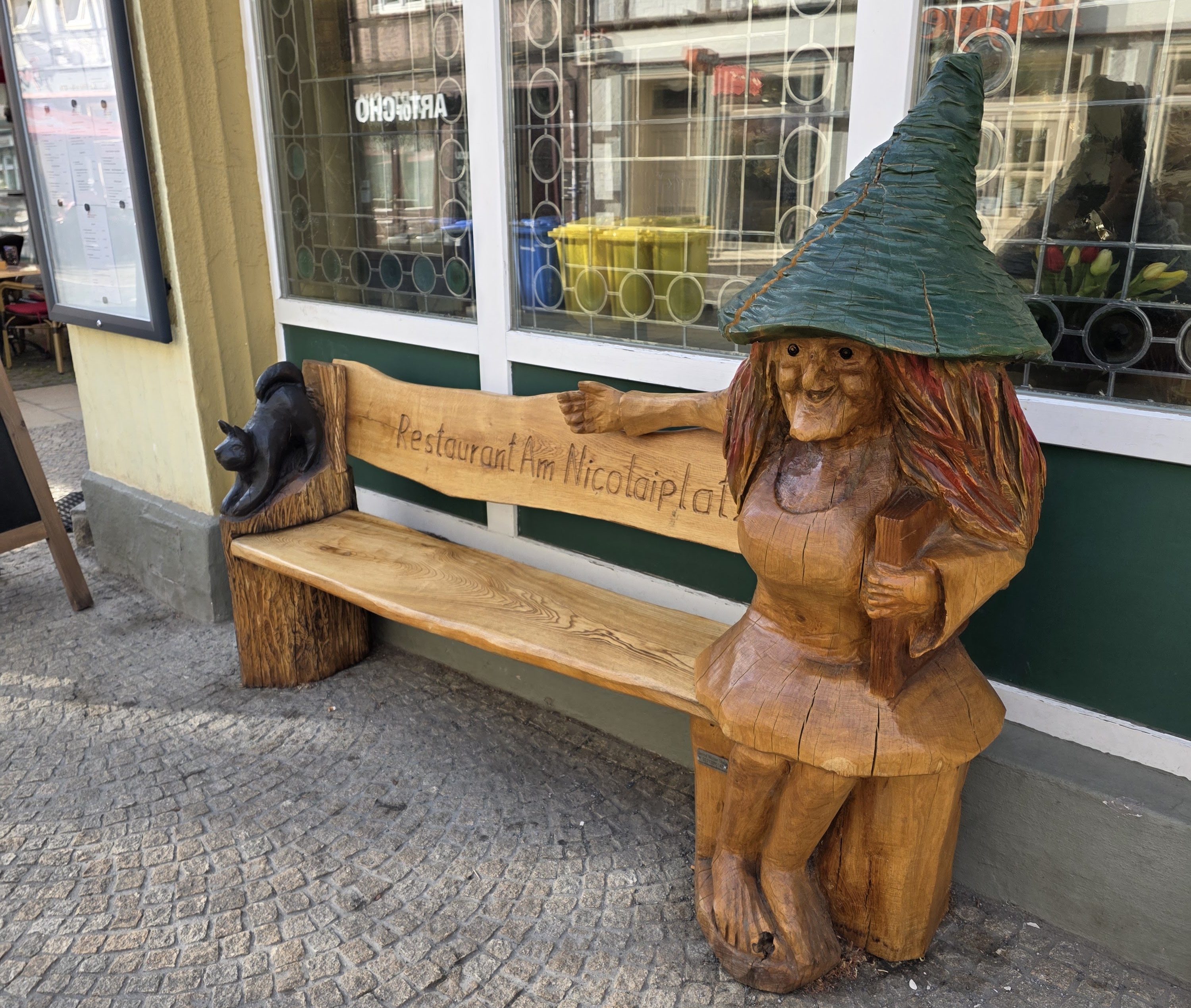
Before going up Brocken, the highest peak in the Harz mountain range, I stayed in Wernigerode, a town nestled beneath the mountains and under the gaze of its hilltop castle. After several weeks in cities and places shaped by tourism, I was glad to be somewhere quieter, cozier, and less commercial with its cobblestone streets and half-timbered houses. Witch imagery was peppered throughout the town, in shop displays, on souvenirs, on a carved bench, and there was even a stop/walk sign that featured a witch and a devil. However, the theme never overwhelmed the town the way Nessie does in Innverness or mermaids do in Copenhagen. Instead, the occasional witch served as a reminder of the legends surrounding Brocken.
In German folklore,Walpurgis Night is celebrated on the night of April 30 and into May 1, the eve of the Christian feast of Saint Walpurga. According to the legends, witches gather on Brocken that night to participate in rituals and meet with the Devil. The townspeople once lit fires on the hillsides to protect themselves from the witches, their magic, and any spirits they might conjure. Today, the tradition has become a spring festival marked by bonfires, costumes, and celebrations of winter’s end.

When Goethe trekked through the Harz Mountains in December 1777, he ascended Brocken and captured his impressions in his poem “Harzreise im Winter.” He also drew inspiration from its scenery and folklore, and the influence is most felt during the Walpurgis Night scene in Faust, Part One, when Mephistopheles takes Faust to Walpurgis Night on Brocken, where witches, demons, and spirits have gathered and Faust witnesses the rites and rituals. Mephistopheles intends to use the spectacle to lure Faust further from morality and expose him to a world of evil and forbidden knowledge. But during his visit is when Faust has a vision of Gretchen imprisoned and he, at long last, makes the choice to return to her and attempt to save her from her fate.
Unlike Faust, my particular quest for knowledge and experience did not come with a spirit guide who can whisk me up a mountain, so I had to rely on public transportation. From Wernigerode, I took a train and then a bus to Torfhaus, where I joined the Goetheweg, the trail named for our boy. The route is theorized to follow Goethe’s ascent taken, but no one can know for sure.
Of course, the landscape I saw was vastly different from the landscape Goethe encountered centuries earlier. He ascended Brocken in December, though a landscape covered in snow, while I was here in the spring and was soon greeted by sunshine, the trees in bloom. Whereas my surroundings gave evidence of life in springtime, Goethe would have walked through a hibernating landscape.
The forest has also changed since Goethe’s time. The mountain was once covered by spruces, but many of those trees have since fallen victim to bark beetles. While healthy spruces can defend themselves with resin, the unhealthy spruces that have been diseased or weakened by climate change don’t have the same ability. Warm, dry years also allow the beetles to reproduce rapidly, creating the conditions for them to destroy more of the forest. Areas that might have once been filled with green needles are now stripped bare, white and gray trunks flanking the trail and their branches poking outward like scarecrow arms.
On the whole, the Harz National Park generally leaves core zones of the forest to natural processes, allowing the forest to react naturally without human interference. Along the trail are information signs, explaining that even the dead trees are contributing to the ecosystem. Deadwood provides food and shelter for many species, including endangered ones, and 20-30% of forest organisms depend on it for their survival, according to the information signs on the trail.

I follow the signs for Goetheway, and every now and then I see a trail marker of what I think is a witch riding a broom, a playful reminder of the Walpurgis Night legends. The day had started gray, but the clouds soon gave way to blue skies, and I was able to shed my jacket. Even in the sunshine, however, the forest retained something eerie. I could imagine being here when it was darker, when mist settled along the path, weaving between the trees, thick enough to conceal whatever might be lurking beyond them. I’d caught a glimpse of that version of the mountains from below the day before, when their peaks were shrouded in blue-gray mist, giving the mountains an ominous glow. The trail rose gradually at first, then steepened as I neared the summit. When I turned to look back down, I was standing high above the valleys, watching the shadows of clouds drift across the ground below.
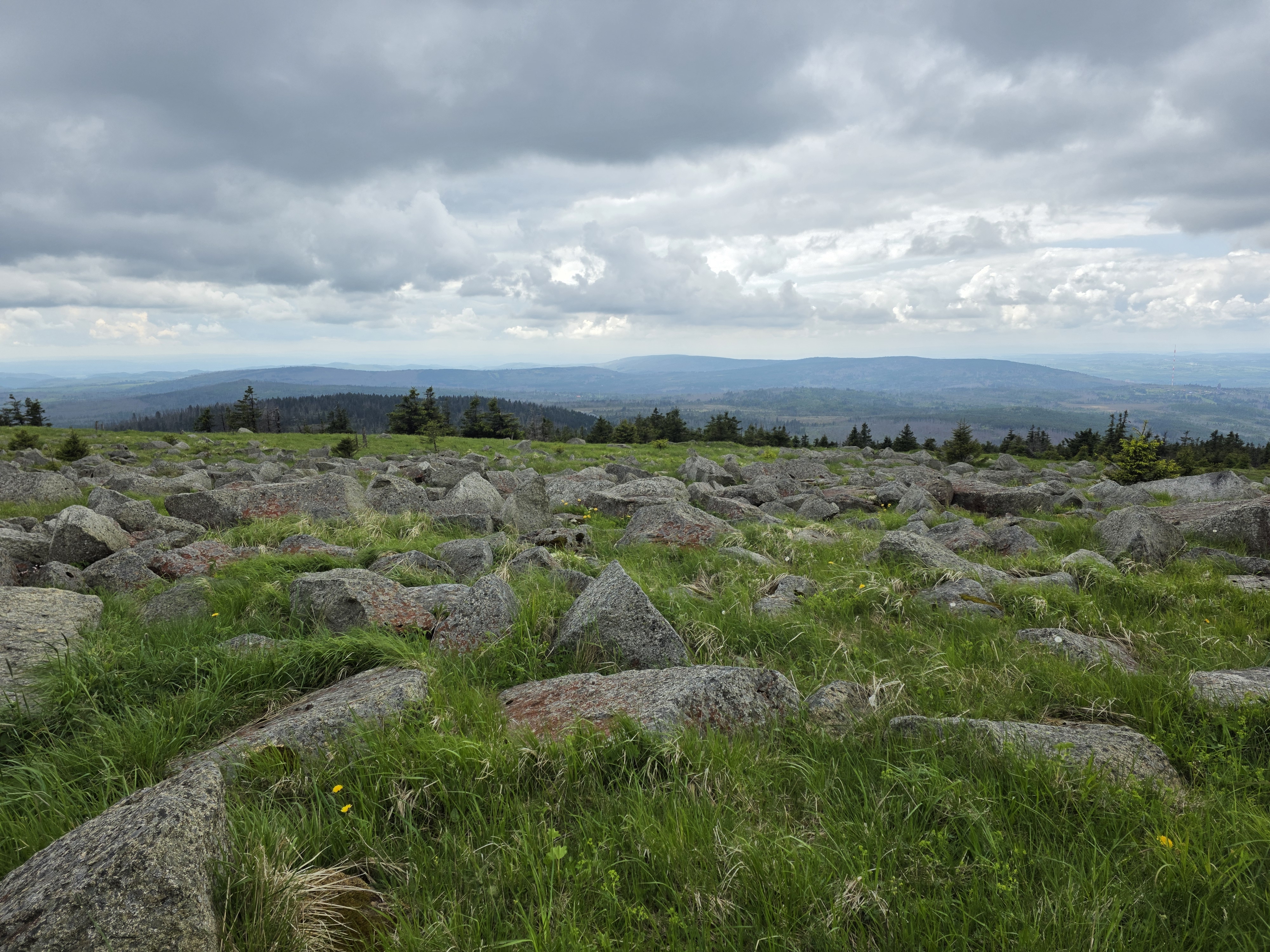
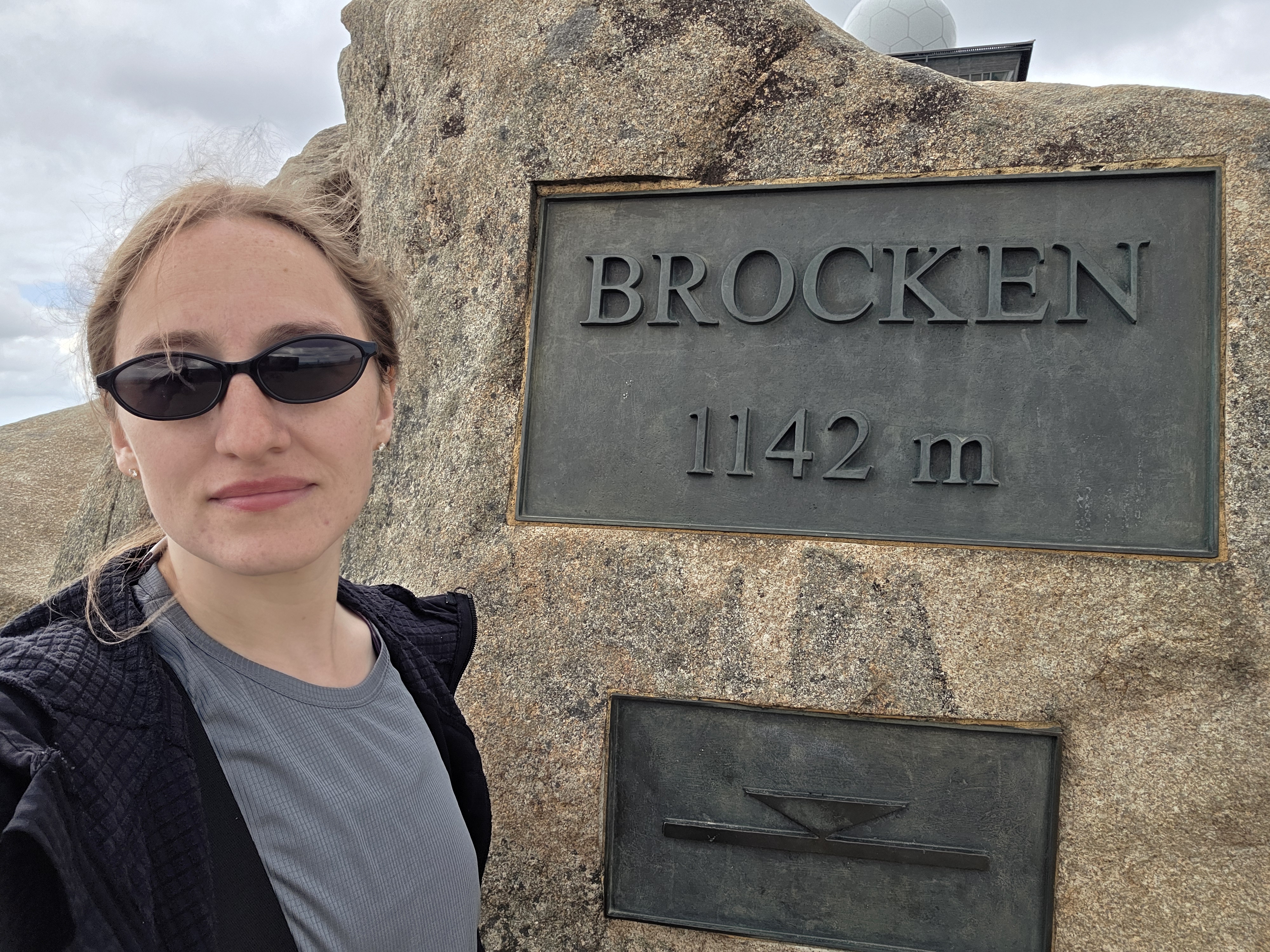
As I approached the summit, the air cooled, and occasional gusts cut through my clothes and rattled my bones. Rocks and boulders erupted out of the green grass, and I could easily imagine how eerie the summit would become when fog settled over it. By then, the blue sky had given way to dark gray clouds hanging so low that they seemed almost within reach. If I reached up, my fingers might pass through them like a ghost. At the top, a maker announced Brocken’s elevation of 1,142 meters. Nearby stood the visitor center and a small one-room hut bearing a sign that said Goethe had stayed there on December 10, 1777.

I walk around the summit, taking in the scenery, hugging my jacket that I had to slide back into as I made my way to the top. I wouldn’t be walking down but rather catching the steam engine back to Wernigerode. As I wait for the train to arrive, I am hit with that familiar feeling I’ve had repeatedly throughout this trip. This is where a writer that changed literature walked, I can see what inspired them. Centuries from now, where will travelers go to see what inspired writers? What will their views be? How much will those views have changed between the present writer and the future visitor?
Frankfurt
From Wernigerode, I traveled to Frankfurt, which felt loud after the serenity of the small mountain town. The city roared with sirens, street sweepers, and leaf blowers cutting through the chilly morning. I walked to Römerberg, the historic square lined with reconstructed half-timbered buildings and anchored by the Römer city hall, then crossed the Eiserner Steg over the Main River to see the city from the opposite bank. Like many major bridges I’d crossed, it’s railings were chock-a-block with padlocks, some rusty, some new, and others interlaced because there was no space left on the metal grilles. I imagined how many people decided to come here, making the choice to bring a lock and place it, promising to love each other forever or at least in the moment. I cynically wonder how many of them are still together, whether anyone came here to mourn the old times or to remove the lock.


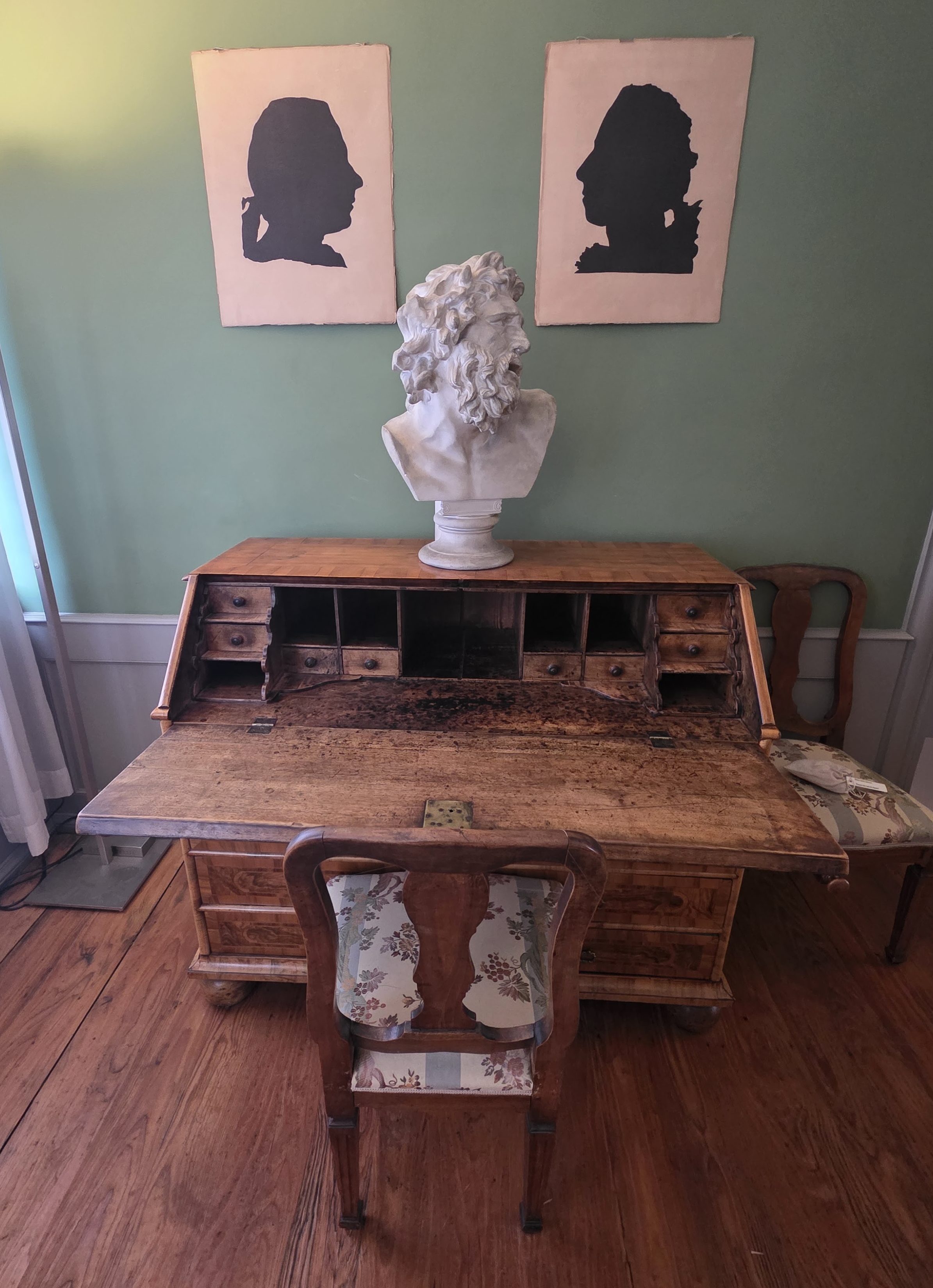
Then I headed towards my reason for visiting: the Goethehaus (the Goethe House & Museum), Goethe’s birthplace and childhood home. The original building was destroyed during World War Two, but the furniture and collections had been put in storage and survived. Between 1947 and 1951, the house was faithfully reconstructed, capturing the changes Goethe’s father had made when he came into possession of the house. The house consists of three floors. Unlike other literary homes I’ve seen, there are not descriptions of each room or signs describing the objects, but rather a laminated guide, available in multiple languages, is provided to describe each room and there are people available to answer questions; this is intended to help preserve the feeling of it being a house. The rooms include the chamber where he is said to have been born, paintings by contemporary Frankfurt artists his father collected, and the family library of nearly 2,000 books. Visitors also see his sister’s room, the puppet theater that fed his childhood imagination, and the Poet’s Room, where the young Goethe worked.
One room does contain a timeline tracing Goethe’s life from his birth through 1775, when he accepted an invitation to settle in Weimar, though he does return to Frankfurt for visits. A separate timeline outlines the history of the house through changes in ownership, its years with the Goethe family, its opening to the public, its wartime destruction, and its reconstruction. A map also identifies other Goethe-related landmarks around Frankfurt, including his parents’ graves and the execution site of Susanna Margaretha Brandt, whose case inspired Gretchen’s character in Faust. Visitors with more time could use it to continue exploring Goethe’s Frankfurt beyond the house.

Right next door to the Goethehaus is the Deutsches Romantik-Museum (German Romanticism Museum). When you purchase your ticket, they allow entry for the Goethehaus and the museum, so I would recommend taking advantage of both. Though Goethe is largely recognized as a proponent of Weimar Classicism, his work also had a significant influence on the Romantic movement that followed him. We can see some Romantic ideas in his work. For me, they especially stood out when reading Faust, Part Two, which contain references to the healing and restorative qualities of nature, traits often associated with Romanticism.
The art museum explores Romanticism as a whole, but there is a gallery with a particular focus on Goethe. The gallery displays portraits of Goethe from various points in his life as well as the art and artists that would have been prominent at the time in Frankfurt, so we get to see art that influenced his sensibilities and his writing, and how in turn his writing inspired artists.
Final Thoughts
The separate locations provided a nice contrast that helped shaped my view of Goethe. On Brocken, I had a chance to take a vacation from city life and to encounter the landscape that inspired Goethe. At the Goethehaus, I saw the rooms, books, pictures, and family influences that helped shape the young writer before he left for Weimar. I was able to see the place that shaped him and a place that influenced his writing, which combined gave me the image of a man who lived a dynamic life, on spent observing and growing based on what he witnessed.